
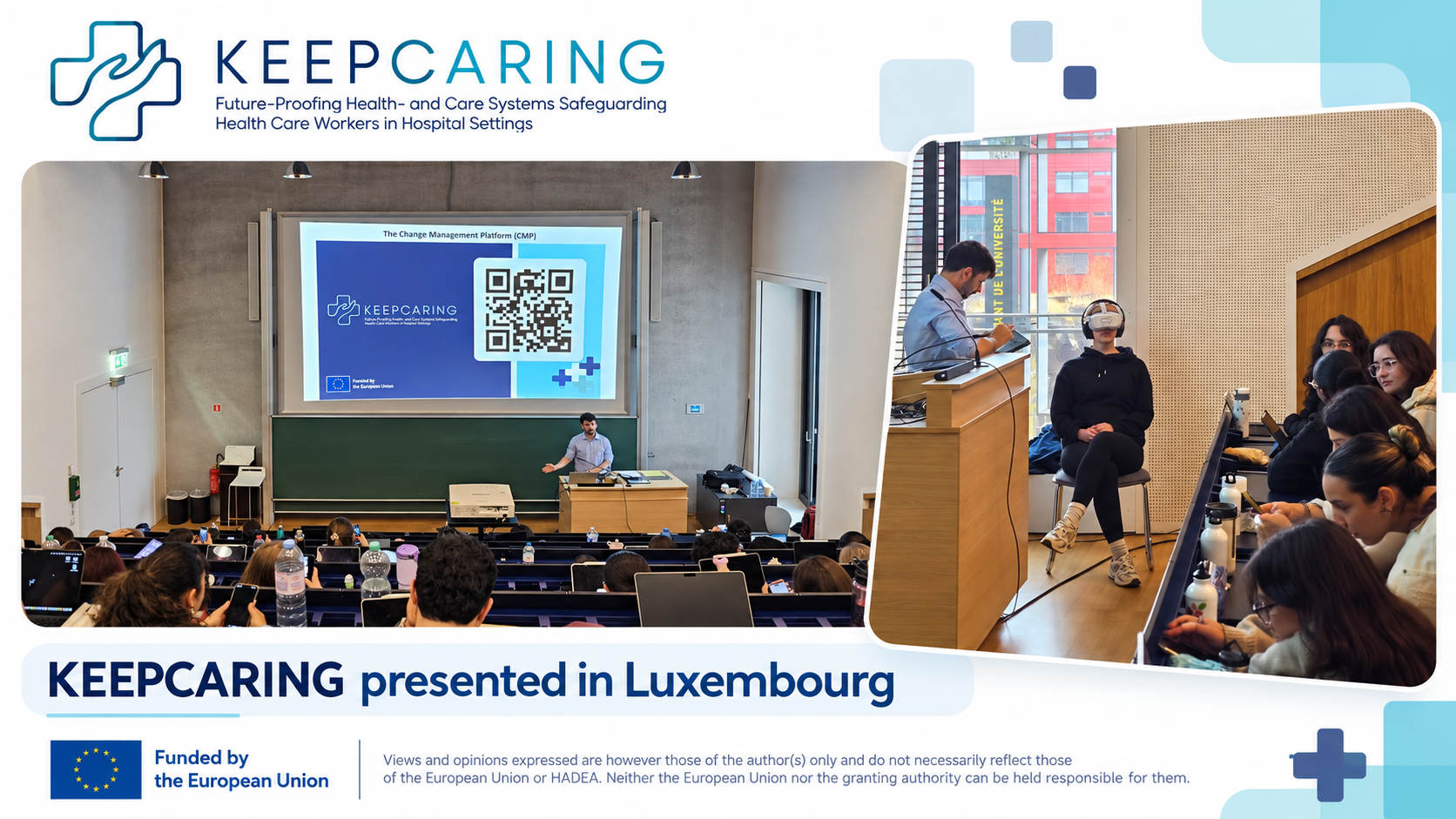
On 1st October 2026, the European Federation of Nurses Associations (EFN) presented KEEPCARING to more than 50 postgraduate nurses at the University of Luxembourg as part of the project’s national communication and dissemination activities.
The event offered participants the opportunity to learn about the latest developments in KEEPCARING and to experience some of the project’s solutions first-hand.
EFN presented an overview of KEEPCARING and its six clinical studies, which are investigating stress and stressors affecting healthcare professionals and testing different approaches to improve wellbeing and resilience and prevent burnout. The knowledge generated through these studies will contribute to the development of the KEEPCARING Change Management Platform (CMP) and to the project’s wider objective of supporting healthier, more resilient and future-proof health and care systems.
Exploring the KEEPCARING Change Management Platform
During the session, EFN showed a video introducing the Change Management Platform and its main functionalities. The CMP is being developed to support healthcare professionals and hospital managers in identifying solutions and interventions that respond to the specific needs and challenges of their working environment.
The concept generated positive feedback among the postgraduate nurses. Many participants indicated that they could see themselves using such a platform in the future to monitor their stress levels and access evidence-based interventions aimed at improving their wellbeing and resilience.
Experiencing KEEPCARING’s VR solution
Participants also had the opportunity to test the Virtual Reality (VR) solution developed within KEEPCARING. The solution is currently being tested at Amsterdam UMC and Rigshospitalet Copenhagen to assess whether the use of VR before working in the operating room and during shifts in surgical wards can contribute to reducing stress and improving resilience among healthcare professionals.
The hands-on demonstration was well received and also prompted an important discussion about how wellbeing interventions need to fit into the reality of healthcare professionals’ working lives. Some participants highlighted the very limited time nurses may have for breaks during demanding shifts, particularly in surgical wards and operating rooms.
This feedback reflects one of the key principles behind KEEPCARING: interventions are co-created and tested with frontline healthcare professionals. Understanding their practical constraints, working conditions and real needs is essential to developing solutions that can be effectively used in everyday healthcare settings and support their long-term exploitation.