
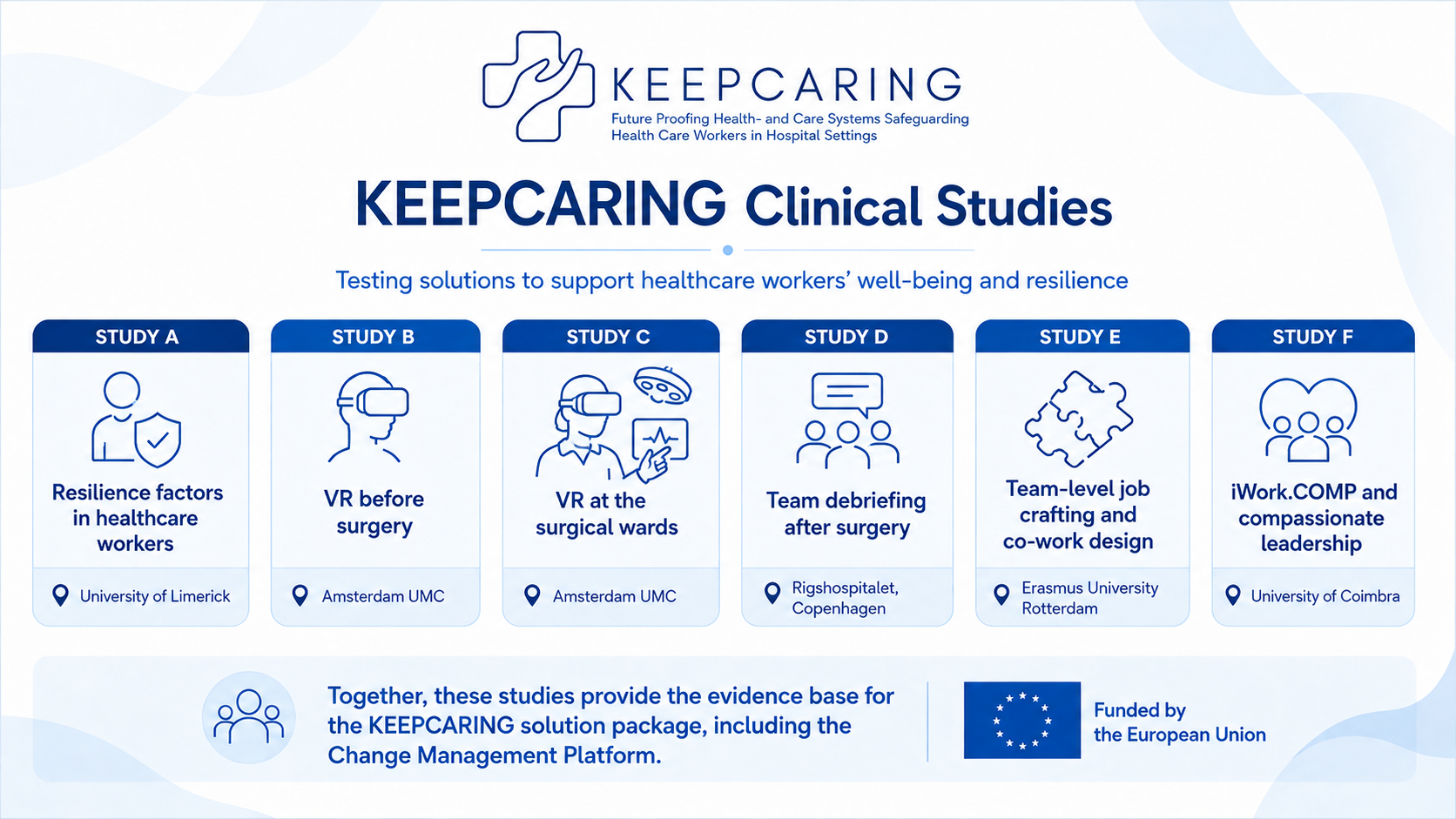
Testing solutions to support healthcare workers’ well-being and resilience
Date:16th September 2026
Reflecting recent EU policy frameworks, healthcare professionals working in hospitals face increasing levels of stress, workplace pressure, and emotional demand. These systemic challenges directly impair staff well-being, undermine workforce resilience, and ultimately threaten the overall quality and safety of patient care [1] [2].
KEEPCARING addresses this issue by developing and testing a set of complementary solutions to better understand, prevent and reduce burnout among healthcare professionals in hospital settings.
At the heart of the project is a series of Clinical Studies designed to explore stress, resilience and well-being from different perspectives. Together, they look at individual, team and organisational factors, while also testing practical interventions that can support healthier and more resilient healthcare workplaces. These studies provide the evidence base for the KEEPCARING solution package, including the Change Management Platform, and contribute to the project’s overall objective of future-proofing health and care systems by safeguarding healthcare workers.
Study A – Resilience factors in healthcare workers
Study lead: University of Limerick
Study A focuses on identifying the bio-psycho-social risk and protective factors associated with resilience and burnout among healthcare workers. The study investigates how individual and organisational factors influence resilience in both current healthcare professionals, specifically hospital-based doctors and nurses, and future generations entering the workforce.
Through an observational cross-sectional design, the study collects data on work stress, burnout, resilience and well-being using validated psychometric scales. It also includes a qualitative component that captures the nuances of healthcare professionals’ experiences that a quantitative design often cannot capture, providing a holistic overview. Additionally, a biobehavioural monitoring component using non-invasive tools, is included to explore how different levels of stress and resilience may be reflected in physiological responses.
This study is important because it helps KEEPCARING better understand which factors place healthcare professionals at risk, and which factors may protect them from burnout. By mapping these elements across hospital settings, Study A contributes to a stronger evidence base for designing targeted solutions that respond to the real needs of healthcare professionals and organisations.
Study B – Deep relaxation using Virtual Reality Therapy before surgery
Study lead: Amsterdam UMC
The operating room is a demanding environment, where healthcare workers are exposed to high levels of responsibility, time pressure, complex teamwork and emotional strain. Study B investigates whether deep relaxation using Virtual Reality Therapy before working in the operating room can help mitigate stress and promote resilience among healthcare professionals.
The study compares the use of Virtual Reality relaxation with a low-stimulus time-out situation before entering the operating room, in which participants act as own control. Healthcare professionals are invited to use a VR headset for a short relaxation session before surgery, with the aim of reducing stress and supporting readiness before clinical work.
This study investigates the effectiveness of the two interventions for reducing stress. By comparing immersive virtual reality with a low-stimulus environment, it aims to determine whether the VR intervention provides additional benefits for stress reduction.
Study C – Effects of deep relaxation using VR at the surgical wards
Study lead: Amsterdam UMC
Study C also focuses on Virtual Reality, but in a different hospital context: the surgical wards. While Study B looks at the effect of VR before surgery, Study C explores whether VR-based deep relaxation can be feasible, acceptable and useful for healthcare professionals working on surgical wards during their shifts.
Using both quantitative and qualitative methods, the study investigates user satisfaction, perceived stress reduction and the practical conditions for using VR in daily hospital work. It aims to understand when, how and by whom this type of intervention could be used in a way that is realistic and supportive for healthcare professionals.
By focusing on feasibility and user experience, Study C helps KEEPCARING assess whether VR-based relaxation can become part of a broader set of practical tools to reduce stress and promote resilience in hospital settings.
Study D – Longer-term resilience: team debriefing after surgery
Study lead: Rigshospitalet, Copenhagen
Study D focuses on team debriefing after surgery and explores how data collected by the Operating Room Black Box can support psychological safety, resilience and team learning. The operating room is a complex environment where teamwork, communication, patient safety and stress are closely connected.
The study compares teams participating in debriefings supported by data from the Operating Room Black Box with teams participating in a more traditional debriefing (without the use of video- and audio recordings).
The Operating Room Black Box captures and analyses information from the operating room, supporting structured reflection on what happened during surgery and helping teams identify areas for improvement.
This study is particularly relevant because debriefing can help teams reflect on their team performance, improve collaboration and strengthen psychological safety. By exploring the role of data-supported debriefing, Study D contributes to a better understanding of how innovation can support healthier, safer and more reflective working environments in surgical settings.
Study E – Team-level job crafting and co-work design
Study lead: Erasmus University Rotterdam
Study E looks at how teams of healthcare professionals can actively shape their work to improve their well-being and functioning. The study builds on the idea that stress and burnout are not only individual experiences, but are also influenced by how job demands and resources are distributed and managed within teams.
The study includes both a daily diary component and an intervention designed to investigate how job crafting can benefit individual healthcare professionals and their teams. Through job crafting, healthcare professionals are encouraged to reflect on their work, including the demands they face and the resources available to them and to explore ways of optimising their working conditions both individually and collectively.
By examining how teams can collectively create healthier ways of working, study E moves beyond a focus on individual coping strategies, thereby supporting KEEPCARING’s ambition to develop solutions not only at the individual level, but also at the team and organisational level.
Study F – iWork.COMP: mitigating toxic leadership through compassionate motivation
Study lead: University of Coimbra
Study F intends to develop and test the efficacy of the iWork.COMP programme, a brief, low-intensity, web-delivered intervention based on Compassion Focused Therapy, specifically designed to mitigate toxic leadership dynamics through the development of compassionate motivation among healthcare professionals. The study starts from the recognition that stress and burnout are shaped not only by individual factors but also by leadership styles, organisational culture and interpersonal dynamics.
The iWork.COMP programme aims to strengthen compassionate motivation by providing practical strategies to support emotional, behavioural and relational regulation in everyday professional practice, among healthcare professionals and leaders. It consists of brief online sessions and short guided exercises designed to help participants respond to stress and difficult situations in a more constructive and compassionate way.
The study will examine whether the intervention contributes to reductions in perceived toxic leadership, burnout symptoms and related psychological difficulties, while promoting well-being and compassionate motivation among healthcare professionals. Its findings will also contribute to the KEEPCARING Change Management Platform, supporting compassion-informed approaches to healthier workplace cultures and more sustainable healthcare organisations.
A complementary evidence base for healthier hospital workplaces
Together, the KEEPCARING Clinical Studies address different but interconnected dimensions of healthcare workers’ well-being. Some studies focus on understanding stress and resilience; others test digital, non-digital and AI-supported solutions. Some work at individual level, while others focus on teams, leadership and organisational change.
This combination is central to the KEEPCARING approach. By bringing together evidence from different hospital settings and different types of interventions, the project aims to develop a practical and co-created solution package that can support healthcare professionals, teams and organisations in preventing burnout and strengthening resilience.
The knowledge generated through these studies will contribute to the KEEPCARING Change Management Platform and to the wider project objective of supporting healthier, more resilient and future-proof health and care systems.
[1] European Commission. (2023). Communication from the Commission to the European Parliament, the Council, the European Economic and Social Committee and the Committee of the Regions on a comprehensive approach to mental health (COM/2023/298 final). Brussels: European Commission.
[2] European Commission, OECD, & European Observatory on Health Systems and Policies. (2023). State of Health in the EU: Synthesis Report 2023. Brussels: European Commission.
Press release authors
University of Limerick
• Trina Tamrakar, PhD – Postdoctoral Researcher, Department of Psychology, Faculty of Education and Health Sciences; Stephen Gallagher, PhD – Professor Department of Psychology, Faculty of Education and Health Sciences
Amsterdam UMC
• S. Vermeulen – PhD Candidate, Department of Surgery; Anne Feenstra, MD – PhD Candidate, Department of Surgery Rigshospitalet, Copenhagen University Hospital
• Johanne Søborg Hartmann – Operating Room Nurse and Clinical Nurse Specialist; President, FSOP – Danish Operating Room Nurses Association; KEEPCARING PhD Student
Erasmus University Rotterdam
• Luisa Solms – Postdoctoral Researcher, Work and Organisational Psychology
University of Coimbra
• Marlene Paulo – Project-based Researcher and PhD Student, Center for Research in Neuropsychology and Cognitive Behavioural Intervention, Faculty of Psychology and Education Sciences; Diana Ribeiro da Silva - Assistant Professor, Faculty of Psychology and Education Sciences
Global Health Connector
• Natalia Allegretti – Senior Innovation Manager
About KEEPCARING
Funded under the Horizon Europe Programme, KEEPCARING – Future Proofing Health- and Care Systems Safeguarding Health Care Workers in Hospital Settings aims to (re-)build the wellbeing and resilience of the healthcare workforce in EU hospitals. The project brings together a multidisciplinary European consortium to better understand stress and resilience among healthcare professionals and to develop and test complementary digital, non-digital and AI-supported solutions at individual, team and organisational level. KEEPCARING is coordinated by Professor Marlies P. Schijven, MD, PhD, MHSc, Gastro-Intestinal Surgeon, Chair in Digital Health at the University of Amsterdam, Principal Investigator and Principal Educator at Amsterdam UMC. Learn more: https://keepcaring.eu/.
Funding Acknowledgement
Funded by the European Union. Views and opinions expressed are however those of the author(s) only and do not necessarily reflect those of the European Union or HADEA. Neither the European Union nor the granting authority can be held responsible for them.