
As the EU-funded KEEPCARING project enters its third year, researchers and healthcare professionals are looking closely at how innovative approaches and technologies can support staff, enhance learning and contribute to a safer and more supportive working environment in the operating room.
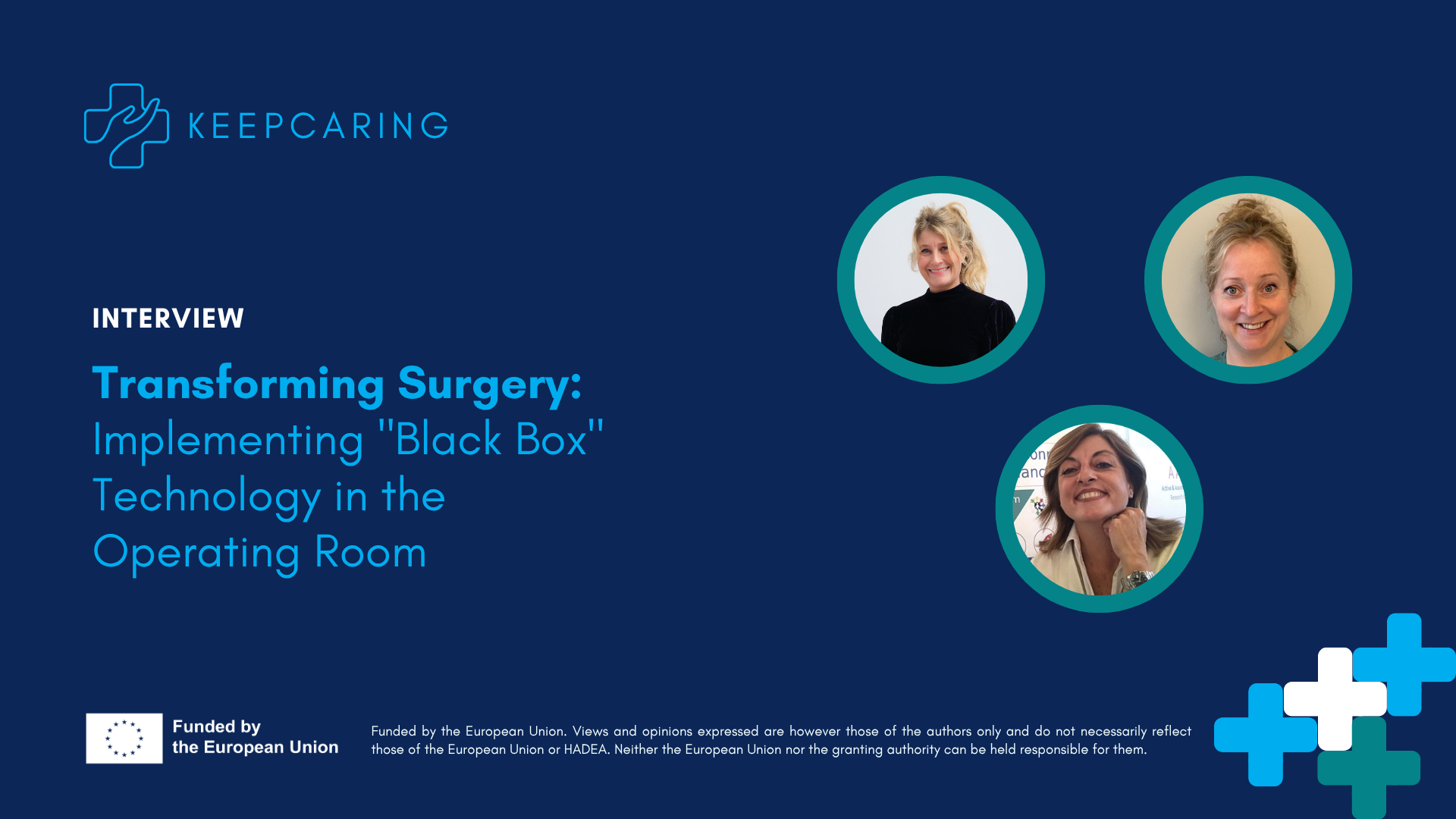
In an interview recorded inside an operating room at Copenhagen’s Rigshospitalet, Natalia Allegretti, Senior Innovation Project Manager at GHC, speaks with Dr Jeanett Strandbygaard, Professor, Obstetric Consultant and Project Lead for the OR Black Box, and Johanne Søborg Hartmann, Operating Room Nurse and Clinical Nurse Specialist, President of FSOP – the Danish Operating Room Nurses Association – and KEEPCARING PhD student.
Together, they share their experience of implementing OR Black Box technology and reflect on how it can support learning, surgical safety and a better understanding of everyday practice in the operating room.
The technology records audio and video footage during surgical procedures, providing an opportunity to review communication, teamwork and decision-making that can otherwise be difficult to fully reconstruct after a complex or high-stress procedure.
Cultivating a Culture of Safety
The operating room has traditionally been a highly confidential and closed environment. Moving towards a setting in which healthcare professionals are recorded while performing complex tasks requires trust and a strong sense of psychological safety.
“We have to learn how to use this in a non-punitive way,” Dr Strandbygaard emphasises. Management is not involved in selecting the footage for review; instead, the approach is designed to be bottom-up, with staff themselves identifying the operations and situations they want to review and learn from.
Despite initial concerns, the experience described in the interview shows a high level of acceptance among both healthcare professionals and patients involved in the initial implementation.
A Higher Level of Education
For Johanne Hartmann, the footage provides a new level of neutral communication. Rather than relying only on individual memories of what happened or what was said during demanding moments, teams can review actual interactions, including closed-loop communication and teamwork dynamics.
The OR Black Box can also provide important opportunities for education and training. Highly specialised surgical procedures that may only take place occasionally can be recorded and subsequently used to prepare and educate healthcare professionals before they encounter similar situations in the operating room.
Addressing Europe’s Healthcare Challenges Together
Different surgical settings – including heart, abdominal and obstetric surgery – have their own workflows, teams and organisational cultures. Through KEEPCARING, partners can explore and compare aspects such as non-technical skills, stressors, psychological safety and debriefing needs across different clinical settings and European contexts.
The broader objective goes beyond the technology itself. KEEPCARING aims to (re-) build wellbeing and resilience of the healthcare workforce in EU hospitals, addressing stress and burnout among healthcare professionals and those in training.
“We can’t initiate 28 different studies around Europe. We need to do this together,” Dr Strandbygaard explains.
With two years remaining in KEEPCARING, the experience at Rigshospitalet provides valuable insights into how OR Black Box technology can be introduced in clinical practice while addressing psychological safety, professional learning, teamwork and the needs of healthcare professionals.
Stay updated on KEEPCARING activities and research, visit: https://keepcaring.eu/.