Virtual Reality innovation to support healthcare workforce resilience

Author
Natalia Allegretti, Senior Innovation Projects Manager at Global Health Connector
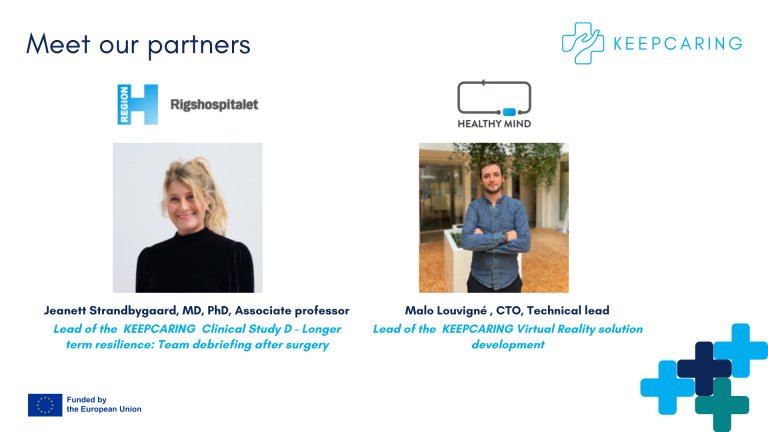
Malo Louvigné , CTO, Technical lead, Healthy Mind
Virtual Reality (VR) technologies are increasingly used in healthcare to enhance patient care, improve training, and support wellbeing. Within KEEPCARING, VR plays a key role in advancing the project’s mission to (re-)build wellbeing and resilience among healthcare professionals and those preparing to enter the profession.
Healthy Mind – an industry partner in the project – brings extensive experience in deploying VR for pain and anxiety management, with its solution already implemented in more than 400 healthcare establishments across Europe, North America and the Middle East. In KEEPCARING, this expertise is being adapted to address a new challenge: helping healthcare workers recognise and reduce stress in real time.
A VR Solution Tailored to the Realities of Clinical Work
Healthy Mind is customising its existing VR tool to fit the needs of healthcare professionals working in high-stress environments, including surgical pathways. The work focuses on two key advancements:
Stress-level measurement through smartwatches and HRV
A stress biomarker based on Heart Rate Variability (HRV) has been developed to measure stress levels continuously and non-intrusively. This allows the VR experience to respond to users’ physiological state, helping them better understand how their body reacts to stress.
A personalised biofeedback experience
The stress measurements feed into a biofeedback system that adapts the VR environment in real time. By learning to modulate their physiological responses during the session, participants strengthen their skills for managing stress in demanding clinical settings.
How VR Fits into the KEEPCARING Approach
VR is one of several digital and non-digital solutions that KEEPCARING is assessing to support stress reduction at the individual and team level in hospitals. The VR intervention will be evaluated through:
- research with healthcare professionals and students, to understand how the tool supports stress reduction in practice
- mixed-methods studies in clinical environments, assessing usefulness, user experience, and real-world impact
- cost-effectiveness analysis, contributing to future recommendations for sustainable uptake
Insights from these studies will contribute to the broader solution package KEEPCARING is co-creating with end users, professional associations, and hospital partners.
The evidence generated will also feed into the development of the Change Management Platform, an AI-supported portal designed to help hospital managers and surgical caregivers identify which combination of interventions best supports wellbeing in their specific context.